EDUGENIA: A TOOLKIT OF EDUCATIONAL STRATEGIES FOR DIGITAL EMPOWERMENT IN ARTIFICIAL INTELLIGENCE FROM A GENDER PERSPECTIVE

This project investigates and develops educational strategies aimed at fostering reflection on the role of Artificial Intelligence (AI) in everyday life, as well as on the ethical and social implications of its use in education from an intersectional gender perspective. The educational strategies are grounded in a transformative feminist pedagogy that encourages and supports the learning and professional development of young women at risk of social exclusion and secondary school teachers, offering them new opportunities and perspectives for their future in an increasingly digitalised society.
The initiative originated from #ACTFEM®, a scenic-technological project for social intervention through the performing arts, created and developed by Plàudite Teatre. At the initiative of Plàudite Teatre, a research was conducted through a collaboration between GenTIC at the Universitat Oberta de Catalunya and the GRIHO group at the Universitat de Lleida, funded the Women’s Institute of the Spanish Ministry of Equality.
The research was co-led by Milagros Sáinz, Director of GenTIC, as Principal Investigator, alongside Marie-Monique Schaper, Serra Húnter Associate Professor at the Universitat de Lleida. The project included training activities, discussions and co-creation sessions with students ans teachers from secondary education centers in Catalonia. The research had a participatory methodological design, combined with formative assessment methods that enable both students and teachers to adjust the course of their learning and adapt the activities to their needs and possibilities. Data collection and analysis included both qualitative (e.g., diaries, interviews, observations) and quantitative (with pre- and post- surveys) research methods. As a result, the project developed EDUGENIA, a co-designed toolkit which contains didactic materials and resources for using AI with a gender perspective in the classroom. The activities designed for female secondary school students also aimed to prevent early school leaving and structural gender violence, which disproportionately affect young women at risk of social exclusion due to intersecting factors of inequality and discrimination, such as gender, ethnicity, or social class.
The Escola de Treball de Barcelona, located in the heart of Barcelona, the Institut Jaume Botey and Institut Bellvitge secondary schools in Hospitalet de Llobregat, and various secondary schools across the Lleida region participated in the study.
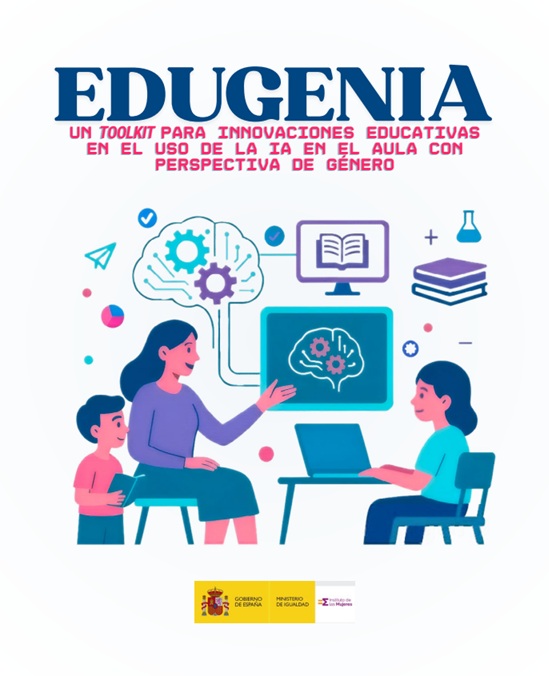
Access the participatory-designed toolkit for educational innovations in the use of Artificial Intelligence in the classroom with a gender perspective, developed by the project team.
Reference:
Sáinz, M. [Milagros], Schaper, M. [Marie-Monique], Bivol, M. [Miruna], Segura, R. [Rocío], López, B. [Beatriz], Romano, M. J. [María José], Gil, R. M. [Rosa Maria], & Teixidó, M. [Mercè]. (2026). EDUGENIA. Un toolkit para innovaciones educativas en el uso de la IA en el aula con perspectiva de género. Instituto de las Mujeres. Ministerio de Igualdad. https://www.inmujeres.gob.es/areasTematicas/AreaEducacion/MaterialesDidacticos/docs/Edugenia.pdf
Funding organisation: Women’s Institute (IMs)
Start date: 15 November 2023 – End date: 15 October 2024
Principal Investigators:
Milagros Sáinz Ibáñez (senior researcher, principal investigator of the Gender and ICT research team at UOC)
Marie-Monique Schaper (Associate Professor Serra Hunter, principal investigator of the research team at Universitat de Lleida)
Research team:
Miruna Bivol (Predoctoral researcher at GenTIC – UOC)
Rocío Segura Nebot (Predoctoral researcher at GenTIC – UOC)
Beatriz López Pérez (Research assistant at GenTIC – UOC)
María José Romano (Research assistant at GenTIC – UOC)
Rosa María Gil (Associate Professor at Universitat de Lleida)
Mercè Teixidó (Assistant Professor at Universitat de Lleida)
An initiative by:

Funded by:

In collaboration with:


Related links:
2026, September 14. UOC News. UOC produces guide to raise awareness of AI’s gender and diversity bias in the classroom.