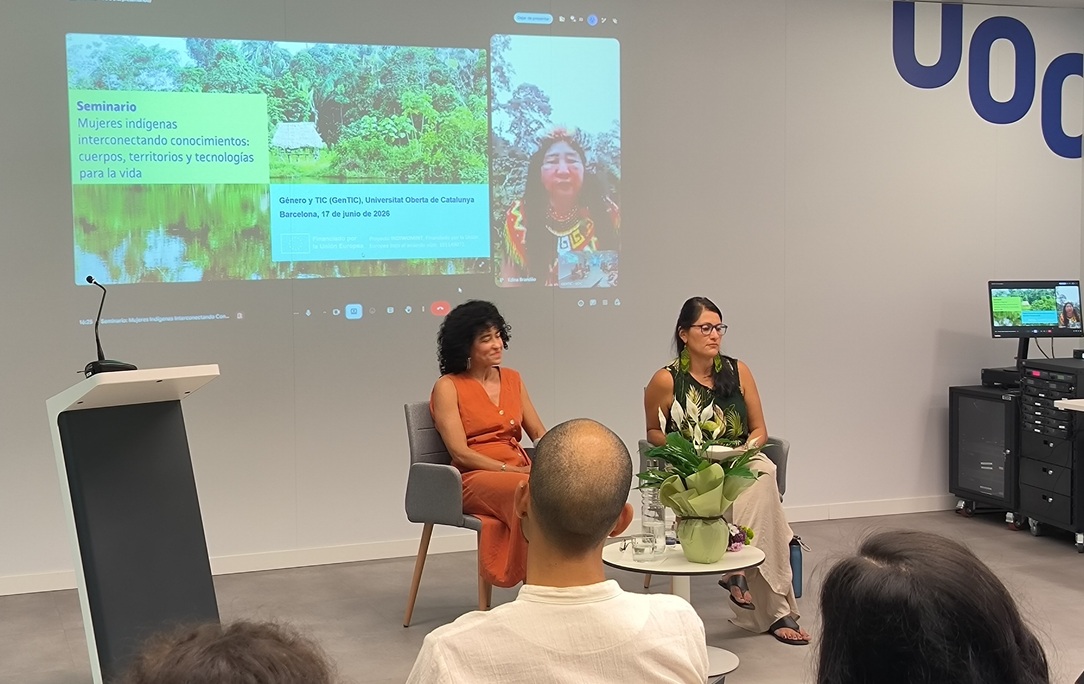
On June 17, we hosted the seminar ‘Mujeres indígenas interconectando conocimientos: cuerpos, territorios y tecnologías para la vida’ [Indigenous Women Interconnecting Knowledge: Bodies, Territories, and Technologies for Life] at the Universitat Oberta de Catalunya. This gathering served to share the main findings of the INDIWOMINT research project, which over the past two years has focused on recognizing the role of Indigenous women’s organizations in the Amazon as knowledge producers and key actors in defending territory, life, and sustainability.
During the seminar, we had the privilege of hearing an online presentation from Pekãshaya Shanenawa (also known as Edna Shanenawa), an Indigenous leader from the Brazilian Amazon, cacica of the Shane Tatxa Kaya village, and a medicine woman. Edna Shanenawa is the co-founder of SITOAKORE, the first organization of Indigenous women in Acre, southern Amazonas, and northwestern Rondônia in Brazil. As a pioneer of female leadership within her community, her trajectory has established her as a pivotal figure in defending territory, culture, and Indigenous women’s rights, breaking ground historically denied to women by asserting the role of the cacica as a political, social, and cultural authority.
Ana María Noguera Durán, Marie Skłodowska-Curie (MSCA) researcher at GenTIC and coordinator of INDIWOMINT, spoke with this renowned leader of the Shanenawa people about indigenous women’s movements in defence of the Earth, for the rights of their communities and for gender equality, and how to foster transnational alliances by integrating Western and indigenous technologies. Edna Shanenawa shared the concept of ‘territory-body-Earth’, which holds that the body is intimately interconnected with the territory of which we form part, through a material, political and spiritual bond. From this perspective, territory is not an inert resource but a living entity with agency, and to defend the territory is to defend life in all its forms.
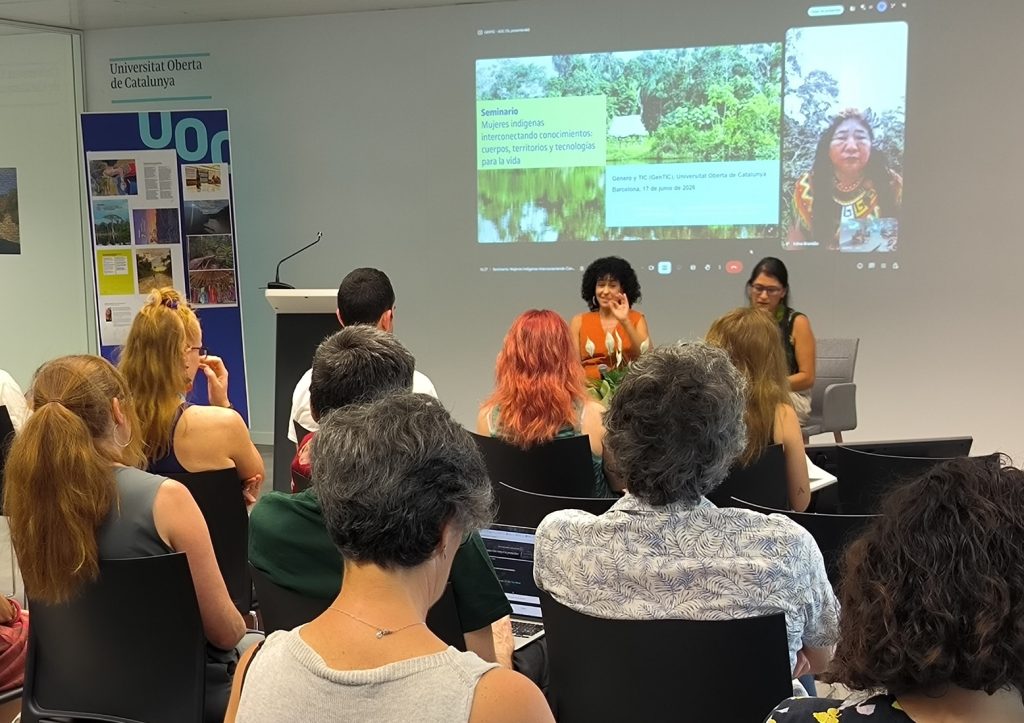
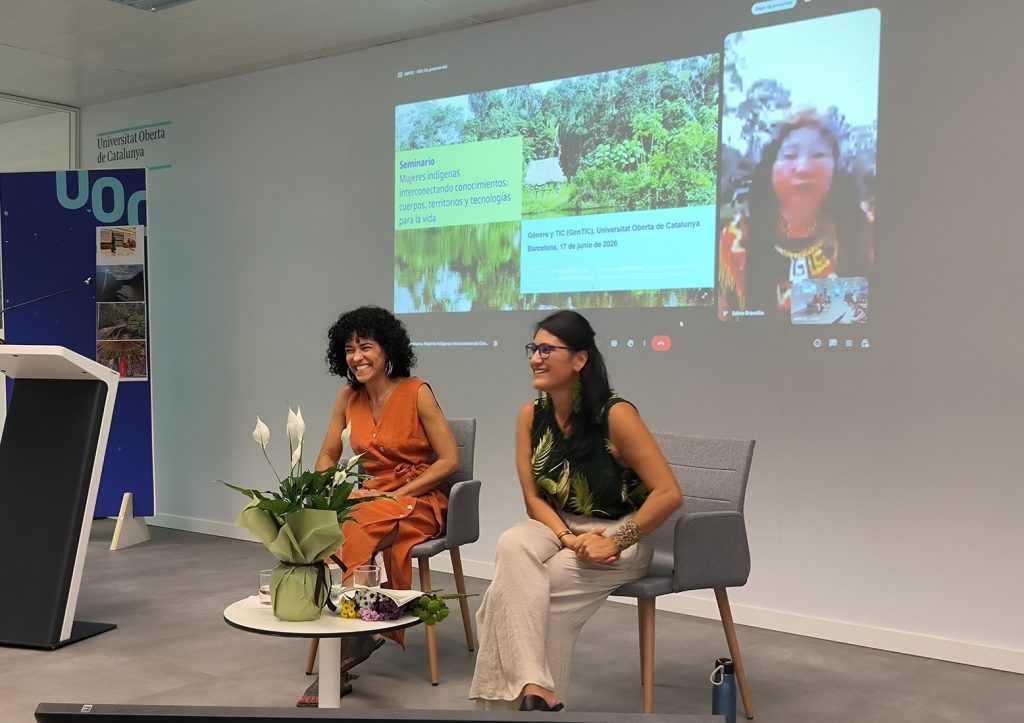
Inés Martins (UOC researcher who helped translate from Portuguese to Spanish) (left); INDIWOMINT coordinator Ana María Noguera Durán (right); and Edna Shanenawa (in the background, on screen).
The cacica highlighted the importance of passing down traditional Indigenous knowledge to younger generations to protect ecosystems, and drew attention to the challenges faced by indigenous women, who must contend with violence and multiple forms of discrimination, including within their own communities. Edna Shanenawa emphasized the need to promote collaboration and create more shared spaces between Indigenous and Western knowledge systems: “We cannot leave the full responsibility of caring for ecosystems to Indigenous communities, because we are all Planet Earth”, she affirmed.
In the INDIWOMINT project, Ana María Noguera Durán has explored the knowledge and practices of Indigenous communities in the Brazilian Amazon to address socio-environmental crises, grounded in the premise that Indigenous women are key actors in ecological and social sustainability. The researcher noted that the climate crisis is tied to an epistemological orientation that privileges hegemonic knowledge while delegitimizing other ways of understanding, such as Indigenous cosmologies. Through empirical research and co-creation, Ana María Noguera Durán has focused on recognizing Indigenous knowledge systems as fundamental technologies for rethinking the necessary responses to mitigate climate change.
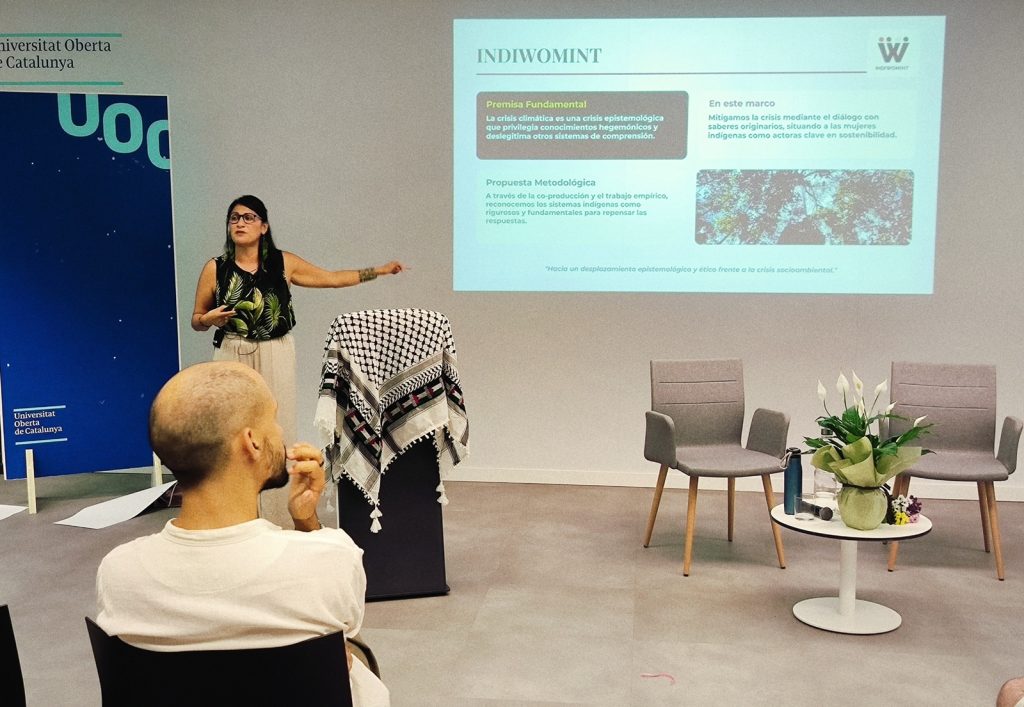
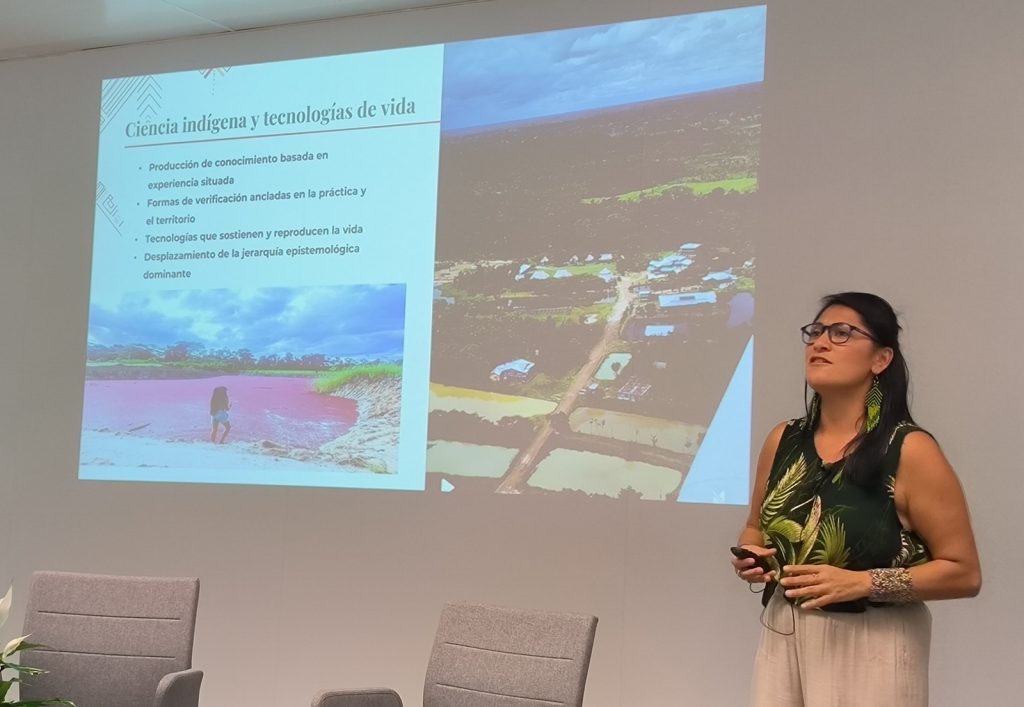
Ana María Noguera Durán during her presentation at the seminar.
During the seminar, we also shared a decolonial guide for research in Indigenous territories and a community guide for the collective use of knowledge in these territories, authored by Ana María Noguera Durán with contributions from GenTIC researcher Jörg Müller.
You can download the research guides below (available in Portuguese and Spanish):
Tejiendo entre mundos: guía decolonial. Para la investigación y acción en territorios indígenas. https://doi.org/10.5281/zenodo.20494051
Guía para el uso colectivo, el cuidado y la continuidad de los saberes en territorios indígenas. https://doi.org/10.5281/zenodo.20494051
We will soon be sharing more publications and resources from the INDIWOMINT project to facilitate engagement with the knowledge and practices of Indigenous women in the Amazon and to promote knowledge plurality in pursuit of social and environmental justice.